
Special US Representative for Pakistan and Afghanistan Richard Holbrooke on Tuesday said that the Obama administration would soon announce a range of actions for Pakistan in the field of water, energy and security.
Pakistan is expected to object to 'India's growing role in Afghanistan' in its key strategic dialogue with the United States this week as Islamabad seeks to torpedo New Delhi's offer to train Afghan forces with a similar offer of their own.
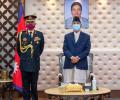
PM Oli said that "there has been good friendship between Nepal and India".

Secretary of State John Kerry arrived in New Delhi onto participate in the fourth round of Indo-US strategic dialogue even as US announced to invest $100 million in India's burgeoning clean energy sector.
Inter-Services Intelligence chief Lt Gen Ahmed Shuja Pasha has embarked on a secret visit to China that is being seen as part of Pakistan's efforts to reduce its dependence on the United States in the wake of strained military and intelligence ties.
Ahead of the crucial Indo-United States strategic dialogue, the Obama administration has said that counter-terrorism cooperation with India is a "very high priority" for it as it would help prevent Mumbai-type attacks in future.

Sweden's backing to India was conveyed to President Pranab Mukherjee, who is in Stockholm on a state visit.
Manifesting the mindset of the Pakistan military and its intelligence arm, the Inter Services Intelligence, Retired General Ehsan Ul Haq, erstwhile chairman of the Joint Chiefs of Staff committee of Pakistan and former ISI director, has said that the Indo-Pakistan composite dialogue, now in limbo was 'a charade'.
The Obama Administration has reiterated its strong commitment to the US-India civilian nuclear deal consummated during the tenure of the previous George W Bush Administration and said it's "embedded" in a broader strategic dialogue between Washington and New Delhi, but contended it's certainly not a template for negotiations with the likes of Iran.
Former ambassador to India Frank Wisner is convinced that "the United States cannot pursue its interests in the world without cooperation with India, and India will not achieve her essential interests without cooperation with the US."
Jonah Blank, former journalist and now policy director for South Asia on the powerful Senate Foreign Relations Committee, believes the Bush administration should have expended its political capital on strongly supporting India's bid for a permanent seat in the United Nations Security Council and being a catalyst in India securing this long-desired position in the world body, instead of the US-India civilian nuclear deal.
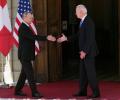
The summit probably fulfilled the expectations on both sides, but the bar of expectations was intentionally kept low, observes Ambassador M K Bhadrakumar.
The United States on Friday described as 'completely inaccurate' media reports that it had offered to mediate between India and Pakistan to resolve their differences over the sharing of river water.Reports in the Pakistani media on Friday suggested that the water dispute between India and Pakistan had come up during the first meeting of the Water Working Group of the US-Pakistan Strategic Dialogue, which was held on Thursday.
In an exclusive interview to Rediff.com, US Assistant Secretary of State Robert O Blake speaks about President Obama's trip to India, the recent US-India Strategic Dialogue and the fate of the nuclear liability bill.
The post-mortem on the United States-India Strategic Dialogue co-chaired by US Secretary of State Hillary Clinton and External Affairs Minister S M Krishna -- which also had the icing on the cake of President Barack Obama attending and delivering remarks at Clinton's reception for Krishna and the Indian delegation at the conclusion of the talks, where he pledged his unequivocal commitment to further US-India ties -- in the eyes of South Asia experts in Washington, DC, was mix

Jaishankar said he was confident that Prime Minister Modi and President Putin will meet for an annual summit next year.
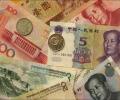
China on Monday assured the United States to reform its currency exchange regime but gave no timetable to address the key irritant in their bilateral ties.
As Washington tries to find its way out of Afghanistan, Pakistan has emerged as the central player dictating the terms of this emerging endgame in South Asia, notes Harsh Pant.
Ahead of the key strategic dialogue with Pakistan, the Obama administration on Wednesday shot down Islamabad's plea to help it resume peace talks with India and mediate on key disputes with New Delhi on issues including Kashmir.
Amid speculations that the United States might offer Pakistan a civil nuclear deal similar to India during the upcoming strategic dialogue on March 24, the US embassy in Islamabad has rejected such reports, saying there are no negotiations on between the two countries on the issue.
Foreign Secretary Nirupama Rao reviewed the progress of India-United States strategic dialogue with top Obama administration officials, including US Secretary of State Hillary Clinton, and briefed them on the recent Indo-Pak talks as well as New Delhi's view point on Afghanistan.
India's 8 percent-plus growth has opened up opportunities where India is, for the first time, in a position to offer unprecedented opportunities to US businessmen in the nuclear power, space and manufacturing sectors.
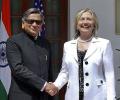
US Secretary of State Hillary Clinton after the second round of Indo-US Strategic Dialogue with her counterpart S M Krishna, made it very clear that there were "issues" which required to be resolved by the two sides in the civil nuclear field. But she did not go into the specifics.

'We should carefully handle issues concerning each other's core interests. We should properly manage and control problems that cannot be solved for the time being'
In the coming week, the United States and Pakistan will hold their third strategic dialogue since March this year and Pakistan is all set to renew its attempt to push for a civilian nuclear deal with Washington.
An India-Japan civil nuclear pact would be critical in signalling that they would like to build a partnership to bring stability to the region at a time when China is going all out to reward Pakistan with civilian nuclear reactors, says Harsh V Pant.

India and Singapore on Tuesday elevated their ties to the 'strategic partnership' level and signed bilateral agreements for enhanced defence cooperation and in areas like cyber security, shipping and civil aviation.
Indian Finance Minister Pranab Mukherjee stresses on stronger Indo-US ties at the CEO meet in Washington, DC.
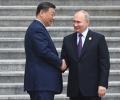
"The two sides note that the relationship between Russia and China has progressed to a more advanced interstate cooperation compared to the military-political unions of the Cold War era as it is not bloc or confrontational in nature, nor does it target any third countries," Russia's new agency Tass quoted the document as saying.
'India should strive to establish itself as a pole in a multi-polar world instead of being a satellite to a sinking America.'
Pakistan has failed to secure a clear commitment for its much sought-after civil nuclear deal from the United States, which has decided to help in upgrading three of its thermal power plants.
Notwithstanding India's reservations, the US said on Tuesday that it would "consider" Pakistan's request for a civil nuclear deal as it wanted to help the country meet its immediate and long-term energy needs. Ahead of the crucial bilateral strategic dialogue between the US and Pakistan on Wednesday, Secretary of State Hillary Clinton made it clear that the issue of energy would be one of the subjects of discussion but refused to pre-judge the outcome of the talks.

The scaling up of the India-US strategic partnership to the level of non-NATO ally with defence deals, sharing and transfer of defence technology, interoperability, joint collaboration and joint production of defence equipment has exacerbated Moscow's anxiety, notes Rup Narayan Das.
The choice of South Korean President Lee Myung-bak this year clearly indicates that New Delhi wants to raise the level of its political relationship with Seoul to a higher level to match its burgeoning economic ties with South Korea.

Prime Minister Narendra Modi on Friday held bilateral talks with Italian counterpart Giorgia Meloni in Bari during which they discussed defence and security cooperation and hoped for further enhancing the defence industrial collaboration.

The 2 countries signed 15 agreements including one on defence cooperation after Prime Minister Narendra Modi held 'productive discussions' with President Joko Widodo.
The US may need to develop a closer relationship with Pakistan to deal with Pakistani state-sponsored terrorism, but it should take India into confidence, writes K Subrahmanyam.

Micromanagers feel the need to be involved in every decision, hence they will avoid delegating tasks and spend a lot of time focusing on minor details rather than the bigger picture, says Sonica Aron, founder of the HR consultancy firm, Marching Sheep.
"Bilateral talks usually focus on a broad range of issues: from the crucial international problems, such as Iraq, Afghanistan, and response to international terrorism, to the coordination of the working issues of bilateral cooperation."
This is the first time such a bilateral dialogue focusing on Central Asia where the two countries have long and historical ties was held, reflecting deepening diplomatic engagement between the two neighbours even as they try to sort out friction resulting from recent reported incursions by Chinese troops along the Ladakh border
